Welcome to GHP Quality Consultants
Links
 
 
HACCP PROGRAM – CONSULTING AND IMPLEMENTATION

HACCP stands for Hazard Analysis Critical Control Points and is a Food Safety methodology that relies on the identification of Critical Control Points (CCP's) in food production and preparation processes. The CCPs are closely monitored in order to ensure that food is safe for consumption.
This differs from traditional "produce and test" quality assurance methods which can lead to expensive "re-call" of suspect food produce.

The HACCP approach was originally derived from Engineering System's - “Failure Mode & Effect Analysis”. It was further developed by Pillsbury / NASA for the American Space Program during the 1960’s because you can't "re-call food in Space".

In 1971 the HACCP approach was presented at first American National Conference for Food Protection. 1973 saw the US FDA apply HACCP to Low Acid Canned Foods Regulations. From 1988 to the present day HACCP Principles are now promoted and incorporated into Food Safety Legislation in many Countries.
HACCP is based on SEVEN Principles. HACCP now complies with all seven principles and is the only HACCP system that can be translated into any language by the end user.
HACCP Program Implementation: (Implemented by our highly qualified consultants who have more than 15 years of experience and are doctorates in their respective field)

 
HACCP program implementation consists of following 5 steps:
1.Gap Analysis/ Structural Survey
2.HACCP Prerequisites
3.HACCP Implementation
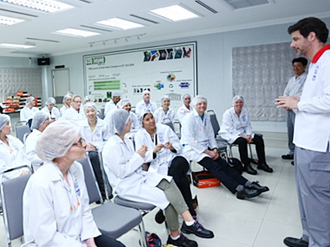
4.Trainings
5.HACCP Manual Delivery
Advantages of HACCP Program
Proactive Food Safety Management System
Enhanced public health
Control over the occurrence of potential hazards in the food supply
Increased consumer confidence in the safety of the food supply
Legal compliance
 
ISO 22000:2005 FOOD SAFETY MANAGEMENT SYSTEM CONSULTING AND IMPLEMENTATION
The International Organization for Standardization (Organisation internationale de normalisation), widely known as ISO, is an international-standard-setting body composed of representatives from various national standards organizations. Founded on 23 February 1947, the organization promulgates worldwide proprietary industrial and commercial standards. It is headquartered in Geneva, Switzerland.[1]

While ISO defines itself as a non-governmental organization, its ability to set standards that often become law, either through treaties or national standards, makes it more powerful than most non-governmental organizations. In practice, ISO acts as a consortium with strong links to governments.

ISO 22000 is a general derivative of ISO 9000. The ISO 22000 international standard specifies the requirements for a food safety management system that involves the following elements:

Interactive communication
System management
Prerequisite programmes
Principles
 
Implementation of ISO 22000
  1- Documentation
  2- Management Responsibility
 
  • Food Safety Policy
  • Regulatory Requirement
  • Communications
  • Emergency Preparedness
  • Review
  3- Resource Management
 
  • Human
  • Infrastructure
  • Work Environment
  4- Production
 
  • Prerequisite Programmes
  • Hazard Analysis
  • Operational Prerequisites
  • HACCP Plan
  • Verification
  • Traceability
  • Control of nonconformity
  5- Validation, Verification and Improvement of the
     Food Safety Management System.
 
Benefits of ISO 22000
  • In 148 countries worldwide - from farmers to food services, to processing, transportation, storage, retail and packaging - ISO22000 is already proving its worth.
  • ISO22000 tackles key issues in the food supply chain, each contributing to an organisation’s ongoing business performance in relation to food safety management.
  • It is flexible and allows an organisation to develop a food safety management system tailored to its particular suppliers, customers and relevant parties.
  • Helps clear communication across the entire supply chain
  • Legal compliance
  • Cost reduction due to a more efficient system